


We need your help to update the WDI survey to ensure it keeps abreast of changes to the landscape and continues to reflect investor and business needs – send us your feedback by Friday 13 March
Introduction
Workforces around the world, and the ways companies report on them, are evolving rapidly. To keep pace with the changing ESG landscape and to continue delivering top-quality insights, the Workforce Disclosure Initiative (WDI) is embarking on a comprehensive revamp of its annual survey. Conducted on a three-year cycle, this revamp will refresh how we collect and share workforce data, ensuring WDI remains a useful framework for both companies and investors and stays at the forefront of workforce management transparency.
Why We’re Updating the WDI Survey
The world of work has changed significantly since the WDI’s last survey revamp in 2023. AI is reshaping how work is designed and managed, post-COVID labour dynamics have sharpened focus on disputes, litigation, and industrial action, and the broader context for workforce disclosure has become more complex and contested across different market, shaped by intensified scrutiny and political debate around ESG in some jurisdictions, while interest and adoption continue to expand in emerging markets. At the same time, reporting requirements are evolving unevenly, with recent simplification efforts revising and extending timelines for aspects of Europe’s CSRD and CSDDD. In this shifting regulatory landscape, WDI not only aligns with key regulatory requirements, WDI also aims to enhance interoperability and support stable, comparable, and decision‑useful frameworks that meet the needs of diverse stakeholders.
Through our ongoing engagement with responsible investors and companies, we have learned that developing a more comparable social dataset is essential to addressing today’s challenges. In particular, feedback has highlighted that highlight that high-level narrative responses can lead to inconsistent interpretation and limit meaningful benchmarking over time.
As a global leader in workforce transparency, WDI is evolving to meet these expectations. By revamping the survey now, we aim to ensure our questionnaire continues to cover the most pressing workforce issues and drives meaningful action with a structured and comparable social dataset.
Our Goals for the Updated Survey
Our goal is to make the WDI survey more efficient, comparable, and insightful for everyone involved. note boxes.
Finally, we will also update our guidance to better reflect company needs and help ensure respondents include the right data points in the right places. This will have the joint benefit of clarifying for companies what the question is asking for, while also generating clear and comparable data for investors and other stakeholders.
We also aim to deepen the insights that can be drawn from WDI data. The updated survey will incorporate emerging workforce topics and evolving disclosure practices, ensuring that reported metrics reflect today’s realities. To add even more value, we plan to update our scoring methodology to better highlight areas of strong workforce management and transparency. The consultation regarding the new scoring methodology is planned to open during March.
A Collaborative Process
This will be an open, consultative process. Our team will work closely with the WDI community, including companies, investor signatories, NGOs, and technical partners, to gather feedback and ideas. Through surveys, webinars, and direct consultations, we plan to incorporate stakeholder input at every key step of the project. This announcement sets up the overall direction and design principles of the revamp; you can see below the various different ways you can get involved in the survey consultation process but if you are interested in providing detailed feedback of the proposed changes, feel free to email us (wdi@thomsonreuters.com) and we will share the proposed changes log with you. All consultation responses and feedback must be submitted by Friday 13 March and the updated survey will be published in early April, in time for the 2026 disclosure window of 6 July to 30 October.
Overview of key proposed changes
The changes outlined below focus on how questions are organised, structured, and guided, rather than providing a comprehensive list of every individual amendment.
Structural changes
- Clearer structure and flow
- We are improving where questions “sit” so companies report information in the most logical place (e.g., moving day-to-day workforce management in value chain content into the value chain section, and grouping demographic breakdowns within Diversity & Inclusion).
Format changes
- Less free text, more standardised answers
- Many questions that previously invited long narrative responses will shift to structured tables, drop-downs, and consistent Yes/No (or Yes/Not yet) gateways, with follow up questions to allow companies to explain context where it is decision-useful.
- Many governance questions, for example, will increasingly capture roles/responsibilities via standardised selections, rather than open-ended descriptions.
- More tables to make data comparable
- We are using tables to separate (and standardise) reporting across:
- Direct operations vs. value chain
- Worker type (employee vs non-employee where relevant)
- Locations (e.g., focusing on significant operating locations without encouraging averaging)
An example of a proposed change to a table-based answer:This is the 2025 question about parental leave:

This is the proposed change:

- We are using tables to separate (and standardise) reporting across:
- Survey design
- Additional tables in the survey may look more detailed at first glance, but in reality, they are designed to be simpler to complete and analyse.
- In some places, it may seem more detailed because we’re collecting more granular data points but in the vast majority of cases, these are data points that have been requested for several years within written answers, and we are only changing the presenting format.
- However, the overall effort required is reduced by replacing open-ended “write anything” fields with consistent response options, which makes completion more straightforward for companies and yields clearer, more comparable outputs for investors
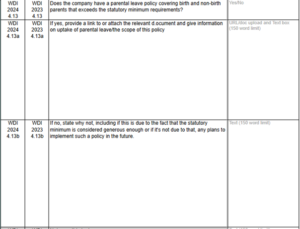
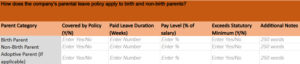
Content changes
- Refined focus on comparability and decision-useful reporting
- Several topics are being reshaped to ensure companies answer the same underlying question in the same way, rather than through varied formats.
e.g. Core human rights commitments that were previously spread across multiple questions will be consolidated into a single structured commitments table with consistent fields
- Several topics are being reshaped to ensure companies answer the same underlying question in the same way, rather than through varied formats.
- More consistent treatment of value chain vs direct operations
- Where relevant, we are splitting questions so investors can compare how companies manage workforce topics across their own operations and their value chain, rather than blending them in one narrative answer.
e.g. Risk/opportunity identification processes and “salient issues” prompts are being reworked into formats that explicitly distinguish direct operations and value chain reporting.
- Where relevant, we are splitting questions so investors can compare how companies manage workforce topics across their own operations and their value chain, rather than blending them in one narrative answer.
- Targeted updates for emerging and evolving workforce topics
- The survey refresh makes room to better capture how workforce risks and management practices are changing (including where AI and automation are becoming material and back to office policy is surging), while keeping responses standardised so data remains comparable across companies.
Improved guidance (where and why)
- More precise guidance to reduce ambiguity
- In areas where free text remains important, we are tightening guidance to encourage short, specific, decision-useful responses (e.g., prompting companies to specify what information is reviewed, in which forum, how often, and how it informs decisions).
- Clearer definitions to improve comparability
- Guidance updates will also reduce inconsistent interpretation of key terms (e.g., clarifying what “resolved” means in incident reporting; reducing subjective thresholds like “substantive” without definition).
Overall changes
Overall 87 questions have proposed amendments either in their question content, format or guidance. You can see a log of what type of change is proposed for each relevant question at the bottom of this page but overall:
| Survey section | Number of proposed changes |
| 1. Governance | 7 |
| 2. Risk assessment and human rights due diligence | 9 |
| 3. Workforce composition | 6 |
| 4. Diversity and inclusion | 11 |
| 5. Workforce wage levels and pay gaps | 7 |
| 6. Stability | 2 |
| 7. Workforce development and adaptation | 11 |
| 8. Health, safety and wellbeing | 11 |
| 9. Worker voice and representation | 7 |
| 10. Grievance mechanisms | 1 |
| 11. Value chain transparency | 5 |
| 12. Responsible sourcing | 5 |
| 13. Value chain working conditions | 5 |
How to get involved
There are various ways you can be involved in the survey consultation process by the deadline of Friday 13 March:
Send us your thoughts
Fill out this short form to quickly give us structured feedback on the proposed changes.
Open webinar
- Register for our upcoming consultation webinar on Thursday 26 March at 2pm GMT
- We will do a survey walkthrough, show examples of new table formats, and discuss of company and investor preferences
Interviews
Request a 1:1 interview slot, for detailed feasibility feedback with one of our team, by email to wdi@thomsonreuters.com.
Written feedback
Submit written comments using the following template to wdi@thomsonreuters.com:
- Section / question reference
- Issue observed
- Suggested change
- Feasibility considerations
- Expected benefit (company clarity / investor comparability)
Questions or queries?
- For queries, interview requests, and feedback submissions contact wdi@thomsonreuters.com
Proposed changes at question level
As outlined above, if you are interested in the detail of each proposed change, please email wdi@thomsonreuters.com for the log.
| Section | 2025 Question number | Proposed change to question content | Proposed change to question format | Proposed change to guidance | Proposed change to online reporting platform functionality |
| 1. Governance | 1.1 | x | |||
| 1.3 | x | ||||
| 1.5 | x | ||||
| 1.6 | x | ||||
| 1.7 | x | ||||
| 1.8 | x | ||||
| 1.9 | x | ||||
| 2. Risk assessment and human rights due diligence | 2.1 | x | |||
| 2.2 | x | ||||
| 2.3 | x | ||||
| 2.4 | x | ||||
| 2.5 | x | ||||
| 2.6 | x | x | |||
| 2.7 | x | ||||
| 2.8 | x | ||||
| 2.9 | x | ||||
| 3. Workforce composition | 3.3 | x | |||
| 3.4 | x | ||||
| 3.5 | x | x | |||
| 3.6 | x | ||||
| 3.7 | x | ||||
| 3.8 | x | x | |||
| 4. Diversity and inclusion | 4.1 | x | x | ||
| 4.8 | x | x | |||
| 4.9 | x | ||||
| 4.11 | x | ||||
| 4.12 | x | x | |||
| 4.12a | x | ||||
| 4.12b | x | ||||
| 4.13 | x | ||||
| 4.14a | x | ||||
| 4.14b | x | ||||
| 4.15 | x | ||||
| 5. Workforce wage levels and pay gaps | 5.1 | x | |||
| 5.2 | x | ||||
| 5.4 | x | ||||
| 5.6 | x | x | |||
| 5.7 | x | ||||
| 5.8 | x | ||||
| 5.9 | x | x | |||
| 6. Stability | 6.1 | x | x | ||
| 6.3 | x | ||||
| 7. Workforce development and adaptation | 7.1 | x | |||
| 7.2 | x | x | |||
| 7.3 | x | x | |||
| 7.4 | x | ||||
| 7.5 | x | ||||
| 7.6 | x | ||||
| 7.7 | x | ||||
| 7.8 | x | x | |||
| 7.9 | x | ||||
| 7.1 | x | x | |||
| 7.11 | x | ||||
| 8. Health, safety and wellbeing | 8.1 | x | |||
| 8.3 | x | x | |||
| 8.4 | x | x | |||
| 8.5 | x | x | |||
| 8.6 | x | x | |||
| 8.10 | x | ||||
| 8.11 | x | x | |||
| 8.12 | x | ||||
| 8.13 | x | ||||
| 8.14a | x | ||||
| 8.14b | x | ||||
| 9. Worker voice and representation | 9.1 | x | |||
| 9.4 | x | ||||
| 9.5 | x | ||||
| 9.6 | x | ||||
| 9.7 | x | x | |||
| 9.8 | x | x | |||
| 9.9 | x | ||||
| 10. Grievance mechanisms | 10.1 | x | |||
| 11. Value chain transparency | 11.1 | x | |||
| 11.2 | x | ||||
| 11.4 | x | ||||
| 11.8 | x | x | |||
| 11.9 | x | ||||
| 12. Responsible sourcing | 12.2a | x | |||
| 12.3 | x | ||||
| 12.3b | x | ||||
| 12.4 | x | ||||
| 12.7 | x | x | |||
| 13. Value chain working conditions | 13.1 | x | |||
| 13.2 | x | ||||
| 13.3 | x | ||||
| 13.4 | x | ||||
| 13.5 | x |